Seattle homes face a unique water damage profile: 38 inches of rain a year, sustained 70–80% humidity from October through April, and a housing stock where roughly 60% of homes were built before 1980 with original cedar siding, asphalt roofs, and inadequate vapor barriers. The result is that water damage in Seattle often starts as a slow leak that does not become visible until weeks of mold, swollen subfloors, and rotted framing have already happened. This guide walks Seattle homeowners through what to do in the first 24 hours, what professional restoration actually involves, and how to avoid the mistakes that turn a $1,500 cleanup into a $15,000 reconstruction.
Key Takeaways
- The first 24 hours after water damage decide whether you face cleanup or full reconstruction.
- Mold begins growing on porous materials within 48 hours of water exposure — Seattle humidity makes this universal.
- Most insurance claims pay for SUDDEN water damage but exclude long-term seepage that homeowners ignored.
What Causes Most Water Damage in Seattle Homes
The four most common sources, ranked by frequency from local restoration call data:
- Roof leaks during atmospheric river events — especially common on homes with original cedar shake or aging composite shingles.
- Failed plumbing in older homes — galvanized supply lines and cast iron drains both fail at 50–70 years; many Seattle homes are now in that window.
- Basement seepage — Seattle hillside homes face groundwater pressure during the wet season; older foundations without adequate drainage take in water.
- Appliance failures — washing machines, dishwashers, refrigerator water lines, water heaters. Single largest non-storm cause.
The First 24 Hours: Your Action Checklist
Step 1: Stop the Source
Shut off the water at the affected fixture or, if you cannot isolate it, at the main valve. For roof leaks, place buckets and tarps to redirect flow. Document everything with photos before moving anything.
Step 2: Cut Power If Water Is Near Electrical
If standing water is anywhere near outlets, switches, or your panel, do NOT walk through it. Turn off the breaker for affected circuits from a dry location, or call your electric utility for emergency disconnect.
Step 3: Document for Insurance
Take wide-angle photos and short videos of every affected area. Open cabinet doors and photograph inside. Pull rugs back. Note the time of day and the weather. Save receipts for any emergency supplies. Insurance adjusters need this within 24–48 hours of the loss.
Step 4: Contact Your Insurance Carrier
Per the Insurance Information Institute, water damage and freezing claims account for ~24% of all homeowners insurance claims with average payouts near $13,500. Call your carrier the same day — delays can be cited as a reason to deny coverage.
Step 5: Start Drying What You Can
Move soaked area rugs out. Lift furniture off wet carpet using foil or wood blocks. Open windows and run household fans IF the area is electrically safe. These slow further damage but cannot replace professional drying.
Step 6: Call a Restoration Professional
Reputable restoration contractors arrive within 60–120 minutes. The faster equipment is on site, the smaller the eventual repair scope. Searching “Water Damage Restoration Near Me” in Seattle finds local IICRC-certified crews who carry the equipment to do this right.
Why DIY Drying Almost Always Fails in Seattle
Three reasons:
- Hidden moisture wicks into wall cavities, subfloors, and insulation. Surface drying does not reach these areas.
- Seattle humidity keeps ambient air at 70–80% relative humidity for half the year. Household dehumidifiers cannot create the moisture differential needed to dry structural materials.
- Mold timeline is 24–48 hours. By the time DIY drying “looks done,” mold colonies are already established in materials you cannot see.
Per the EPA Mold Cleanup Guide, professional drying with industrial dehumidifiers and air movers is the only reliable way to bring porous materials below the 16–18% moisture threshold that prevents mold.
What Professional Restoration Actually Does
A standard IICRC S500-compliant restoration follows seven steps:
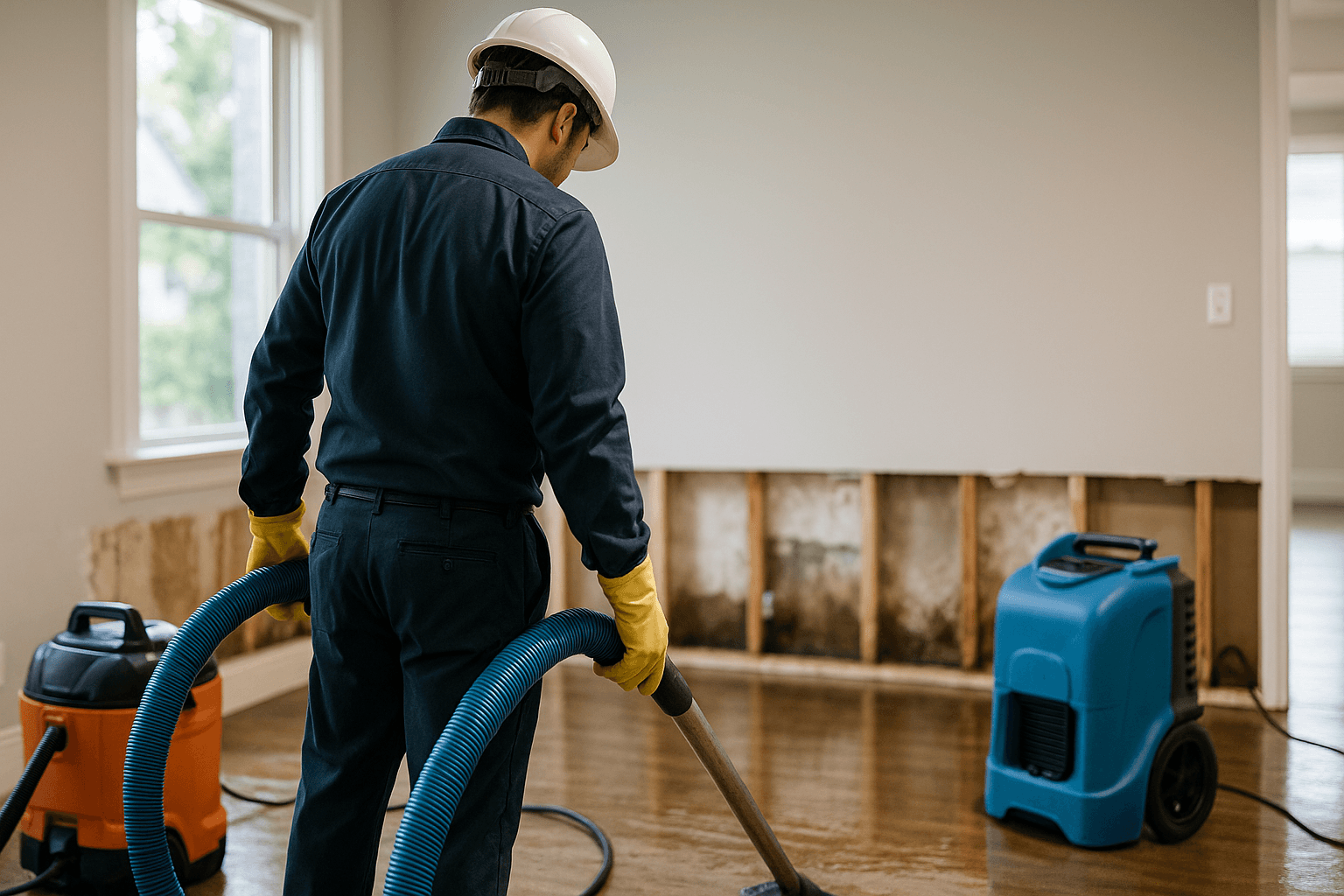
- Inspection and moisture mapping with infrared cameras and pin-type meters to find ALL affected areas — not just the visible ones.
- Water extraction with truck-mounted or portable extractors that remove water at 50–100 gallons per minute.
- Containment with plastic sheeting and negative air pressure to prevent mold spores from spreading to unaffected areas.
- Material removal for unsalvageable items: contaminated drywall, carpet pad, insulation. Saved materials get HEPA-vacuumed and dried in place.
- Structural drying with industrial dehumidifiers and air movers running 3–7 days. Daily moisture readings document progress.
- Antimicrobial treatment of all surfaces that were wet, applied per IICRC S520 if mold was visible.
- Reconstruction to restore the home to pre-loss condition: drywall, paint, flooring, fixtures.
Repair vs Replace: The Material Decision Guide
| Material | Cat 1 (clean) under 48 hrs | Cat 2 / longer wet | Cat 3 (sewage) |
|---|---|---|---|
| Drywall | Dry in place | Replace bottom 2–4 ft | Full removal |
| Carpet | Save carpet, replace pad | Full replacement | Full removal |
| Hardwood | Dry slowly, often saves | Replace if buckled | Full removal |
| Insulation | Almost always replace | Full replacement | Full removal |
| Cabinets (solid wood) | Often save with drying | Inspect for warping | Full removal |
| Cabinets (particleboard) | Replace if soaked | Full replacement | Full removal |
Frequently Asked Questions
1. How much does water damage restoration cost in Seattle?
Cat 1 (clean water, contained): $1,500–$4,500. Cat 2 (gray water, multi-room): $4,500–$12,000. Cat 3 (sewage or major flooding): $9,000–$25,000+. Reconstruction adds 30–60% to mitigation cost.
2. Will my homeowners insurance cover it?
Sudden and accidental water damage (burst pipe, appliance failure, storm event): yes. Gradual seepage and long-term leaks: no. Sewage backup: only with a separate endorsement (most Seattle policies do NOT include this by default).
3. How long does drying take in Seattle?
3–5 days for typical residential damage with industrial equipment. Crawl space drying takes 7–14 days due to limited airflow. Seattle humidity adds 1–2 days vs drier climates.
4. Can I stay in my home during restoration?
For localized damage in one room, yes. For whole-floor or Cat 3 contamination, your restoration contractor will recommend temporary relocation while drying and antimicrobial treatment run.
5. Should I get a second opinion before tearing out materials?
Yes, especially for hardwood floors and solid wood cabinets that look damaged but often save with proper drying. The cost of a second opinion is trivial against the replacement cost difference.
Why Choose J&M Carpet Renewal & Restoration
J&M Carpet Renewal & Restoration provides 24/7 water damage restoration across Seattle, Bellevue, Kirkland, Renton, and the broader King County area. IICRC-certified crews arrive within 60 minutes for emergency calls. We document every step with daily moisture readings, work directly with your insurance carrier, and provide written guarantees on our drying work.
Search “Water Damage Restoration Near Me” or call our 24/7 line. The first hour decides everything — we want to be the call you make.